Pick up any professionally published book and you’ll find pages before and after the main story. These are called front matter and back matter, and getting them right makes your book look polished and complete.
Front matter
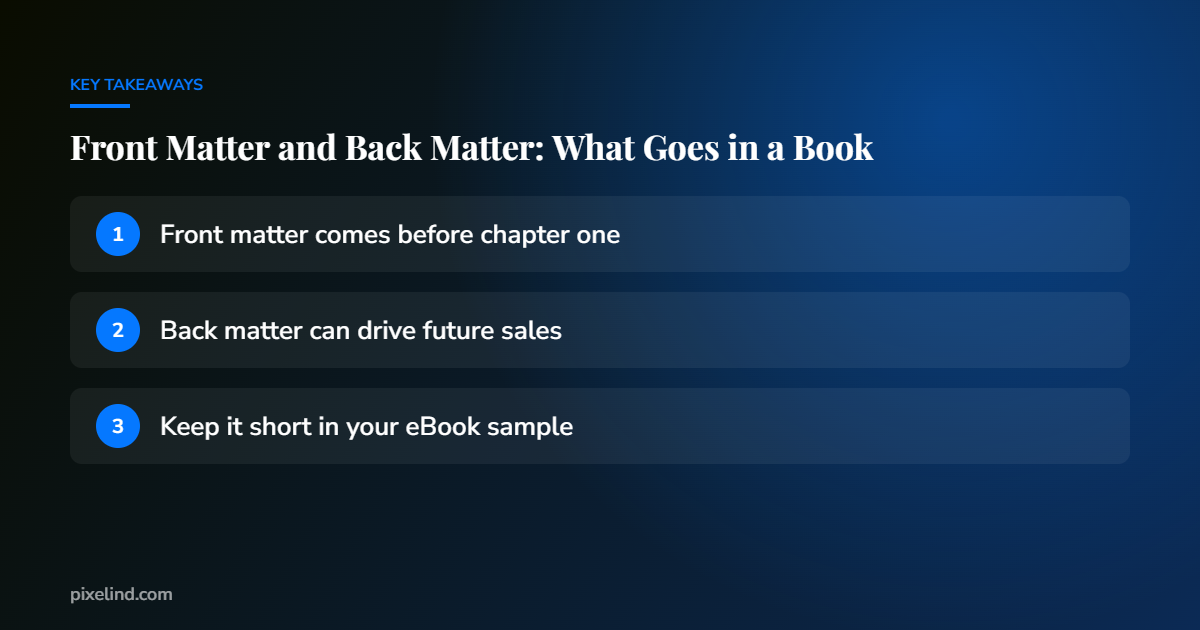
Front matter comes before your first chapter. Common pages include:
- Half title: just the book title, often the first printed page.
- Title page: title, subtitle, author name and publisher or imprint.
- Copyright page: copyright notice, ISBN, edition and any disclaimers.
- Dedication: a short personal note.
- Epigraph: a quotation that sets the tone.
- Table of contents: essential for non-fiction, optional for many novels.
- Foreword or preface: mostly used in non-fiction.
Back matter
Back matter comes after the final chapter. It might include:
- Acknowledgements: thanking the people who helped.
- About the author: a short bio, often with a photo.
- Also by: a list of your other books.
- Call to action: an invitation to join your newsletter or leave a review.
- Notes, glossary, bibliography or index: common in non-fiction.
Use back matter to sell your next book
Readers who finish your book are your warmest audience. Your back matter is the perfect place to invite them to your next book or your newsletter.
Keep your eBook sample in mind
Amazon’s “Look Inside” and free samples start at the beginning of the book. If your front matter is long, readers may reach the end of the sample before the story starts. In eBooks, many authors move acknowledgements and other extras to the back.
Want a book that looks professionally published?
We format interiors and design covers by hand, ready for print and eBook.
See our formatting service, request a free sample or book a free 30-minute call.